

We explain natural capital, a concept that allows us to account for nature’s fundamental contribution to our lives and economies.
Natural capital refers to the natural resources and processes that ensure human health and productivity. With the UK one of the world’s most nature-depleted countries, a natural capital approach aims to demonstrate the critical importance of nature and halt its decline. In this blog, we break down the concept and discuss its importance for organisations, as well as wider society.
What is capital?
Capital is a broad economic concept that refers to assets (both tangible and intangible) which can create value. Value is generally synonymous with “usefulness” and may constitute goods, services, capacity, or wellbeing.
The different types of capital
There are a number of different types of capital, although the exact number varies depending on the context. Different capital types generally represent different types of assets. For example, financial capital refers to financial resources such as bank deposits, profits, bonds, and shares. Manufactured capital includes equipment, infrastructure, and systems that can be used in production processes, and human capital reflects people’s health, knowledge, skills, and motivation, all of which enable them to be productive and fulfil their personal potentials.
What is natural capital?
Natural capital underpins all other capital types. It can refer to the renewable and non-renewable and living and non-living natural resources (regardless of ownership) which, separately or in combination, provide benefits to people (individuals, organisations, and society).
For example, natural capital includes:
- Forests, which provide timber, food crops, and medicinal plants, as well as carbon sequestration, water and nutrient cycling, and erosion control.
- Fossil fuel reserves, wind, and sunlight, which provide energy for transportation, heating buildings, and industry.
- Wetlands, which store water and protect homes and businesses from flooding.
- Urban greenspace, which contributes to the wellbeing of city dwellers, and has cooling, noise reduction, and air pollution regulation functions.
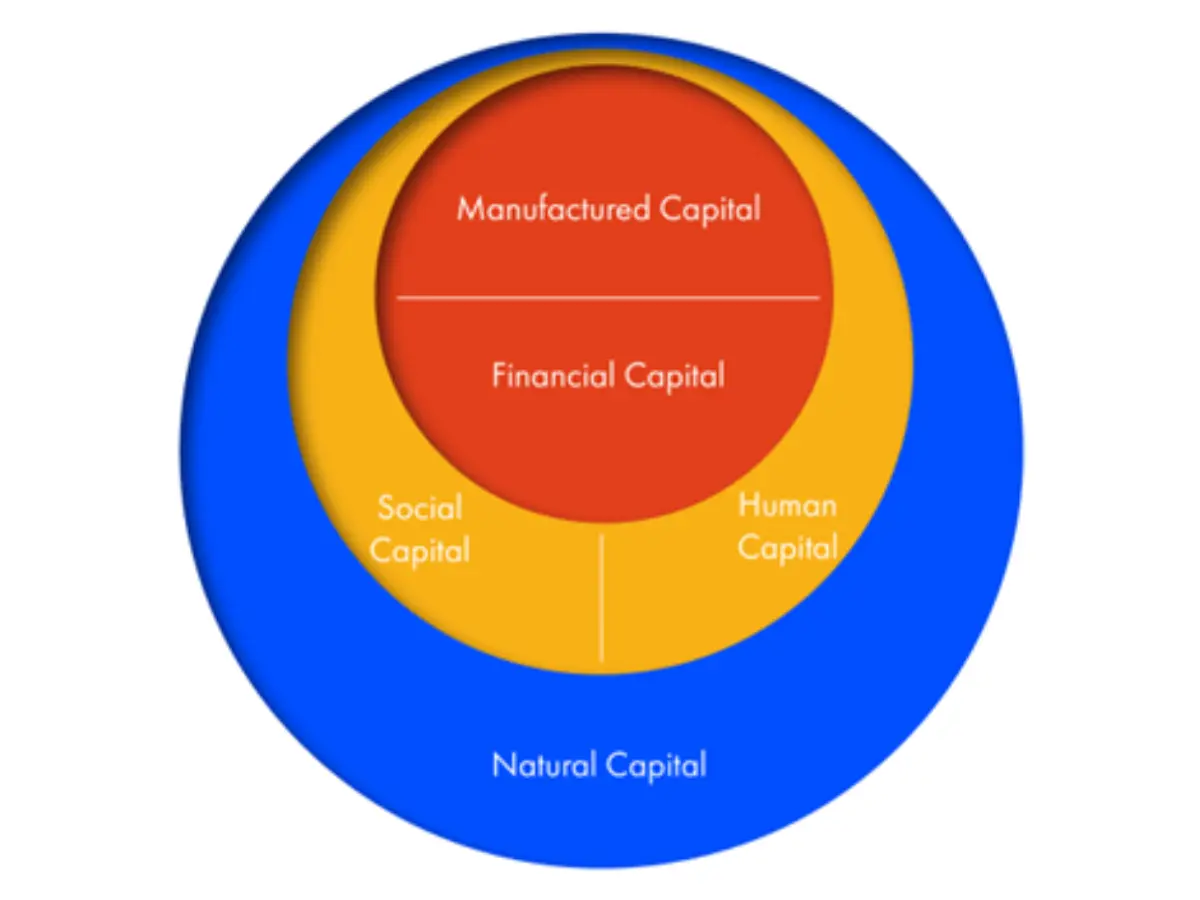
Image source: Forum for the Future.
Natural capital and ecosystem services
Natural capital and ecosystem services are connected, but distinct, concepts. They mirror the economic theory of stocks and flows. Natural capital is the stock (quantity) of natural assets, whereas ecosystem services are the flow of benefits that people receive from that stock. A stock exists at a fixed point in time, whereas flows occur over time. For instance, taking one of the examples above, area of forest would represent the stock of natural capital, and supply of timber to furniture, paper, or construction businesses over time would constitute the flow, or ecosystem service.
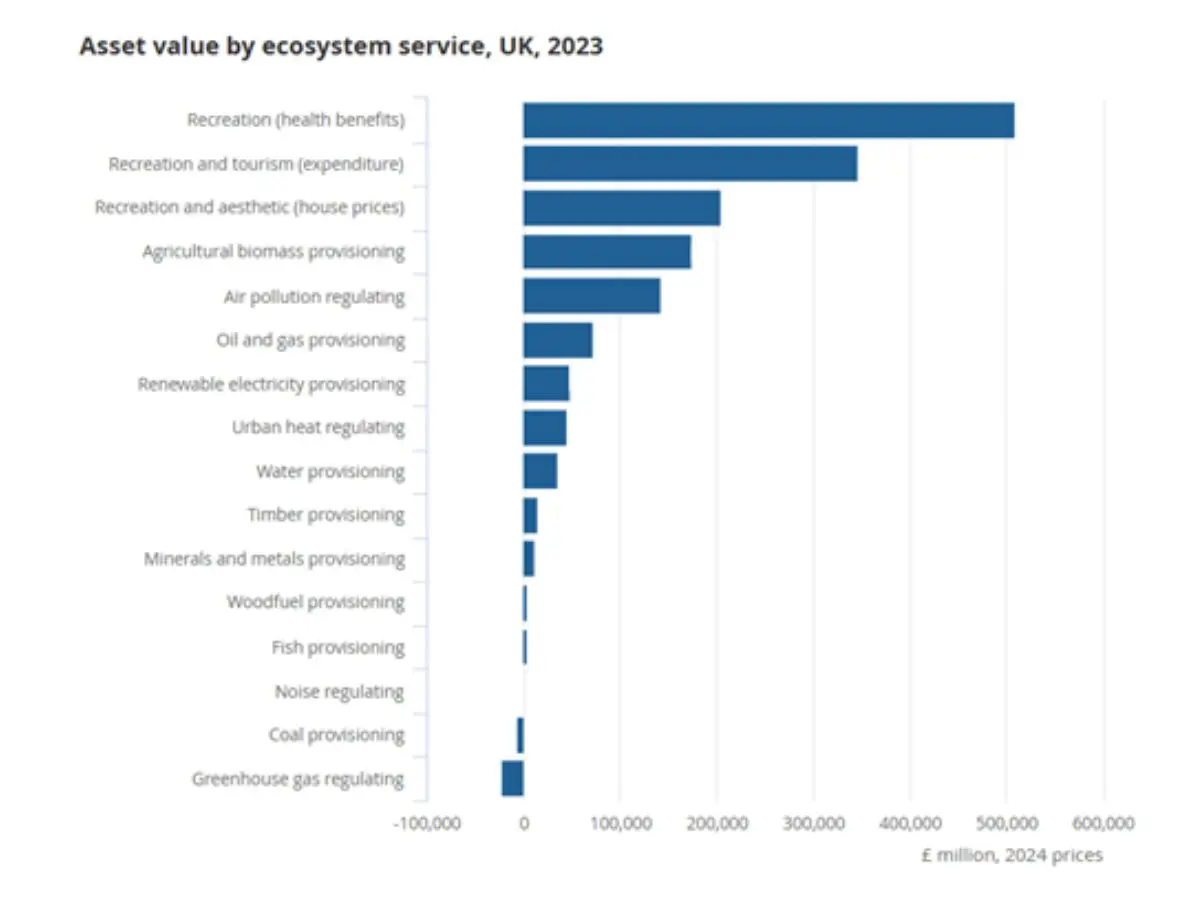
Image source: ONS.
Organisations and natural capital
All organisations impact and benefit from (indeed, they are dependent on) the natural world. A natural capital approach allows these relationships to be realised, quantified, and communicated. It integrates environmental and social considerations into financial reporting – a process that has not traditionally included them. Doing so, however, gives a much fuller picture of an organisation’s risks and opportunities. Particularly as, when an organisation impacts natural capital, they are impacting the ability of nature to continue sustaining their operations, as well as wider society.
A natural capital approach helps organisations understand environmental dependencies and risks, informing better decisions around mitigation, enhancement, and sustainable land use.
Natural capital in policy
Natural capital is an important focus for the UK government, as well as intergovernmental bodies such as the United Nations. The Office for National Statistics (ONS) is developing yearly Natural Capital Accounts within the UK National Accounts (“The Blue Book”) and the government have guidance for public bodies (Enabling a Natural Capital Approach (ENCA)) to aid them in factoring natural capital into decision-making. December’s Environmental Improvement Plan also recognised the importance of natural capital in “kickstarting the economy”, committed to enhancing and reducing pressures on our natural assets, and discussed a “natural capital sector”.
However, as yet, there is no mandate for private companies to carry out full natural capital accounting or reporting, although it is a best practice. As sustainability reporting (e.g., inclusion of ESG in strategic reports, streamlined energy and carbon reporting (SECR), and climate-related financial disclosures under the Companies Act 2006 and its secondary legislation) has become a legal requirement for some companies, the integration of natural capital is highly likely to follow. Particularly given that natural capital provides a holistic structure in which to analyse all other types of capital, as well encourages consideration of issues that are often overlooked, such as those that affect wider society or occur within supply chains.