


Our Products and Applications Consultant, Duncan Mounsor explains why you should measure oxygen in industrial combustion processes with CEMS.
Measuring oxygen (O₂) in industrial combustion processes is essential for efficiency, safety, and regulatory compliance. We break down exactly why it’s required, both for combustion control and for emissions reporting.
1. To optimise combustion efficiency
Maintaining ideal excess oxygen reduces fuel consumption and improves heat rate efficiency.
In chemistry, stoichiometry is the method for balancing chemical equations to calculate the exact amount of individual reactants needed to ensure that all the reactants are used up with no excess left over from the reaction.
For example, a simple combustion equation for burning the methane (CH4) in natural gas is:
CH4 + 2O2 → CO2 + 2H2O + Heat
According to the above stoichiometric equation, a perfectly balanced combustion process would require exactly two oxygen (O2) molecules to burn each methane molecule. The reaction would produce one molecule of carbon dioxide (CO2) and two molecules of water (H2O) along with excess heat to be used for the process. If the equation is not perfectly balanced, for example, if there is not enough O2 to completely combust or burn each CH4molecule, the reaction will produce some carbon monoxide (CO) instead of CO2.
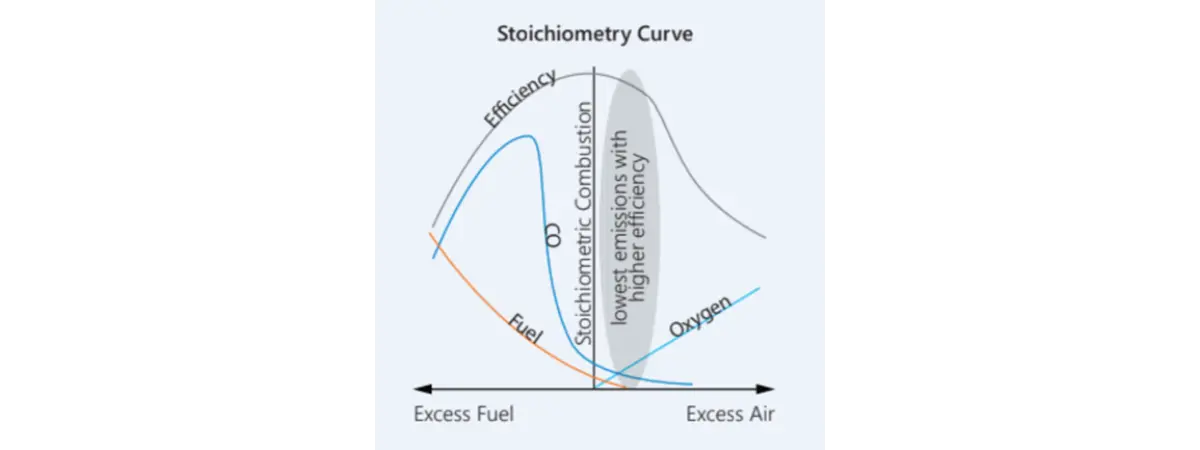
In theory, a perfectly efficient combustion system would operate with a perfect stoichiometric ratio of fuel to oxygen. But in practice, real-world industrial combustion systems need to operate with a slight excess of oxygen in the ratio of air to fuel.
This ensures complete combustion and avoids potential safety issues associated with burning fuel-rich mixtures, which can lead to safety issues.
So, combustion requires the right ratio of fuel and air. Measuring O₂ in the flue gas tells operators whether the system is running with:
- Too little air (fuel‑rich): leads to unburned fuel, wasted energy, and safety risks.
- Too much air (fuel‑lean): wastes energy heating unnecessary air, reducing efficiency.
By measuring oxygen continuously using an oxygen analyser is simple and reliable way to achieve an ideal combustion balance by operating in the ‘sweet spot’ of the stoichiometric curve, resulting in lowest emissions and highest efficiency, therefore maintaining ideal excess oxygen reduces fuel consumption and improves heat rate efficiency.
2. To reduce emissions
O₂ levels directly affect emissions such as:
- NOₓ (nitrogen oxides): Excess air increases NOₓ formation.
- CO (carbon monoxide) and unburned hydrocarbons: Low O₂ indicates incomplete combustion.
- Flue‑gas oxygen measurement is a standard tool for minimising emissions in boilers, furnaces, reformers, and oxidisers.
Operators use excess O₂ and CO as key indicators for achieving the lowest possible greenhouse gas and pollutant emissions whilst maximising combustion efficiency and minimising fuel use.
What is the ideal O₂ concentration for low NOₓ emissions?
For gas‑fired industrial combustion systems, around 3% O₂ is typically the ideal target for minimizing NOₓ while still maintaining safe, stable combustion.
This is the bottom end of the acceptable range (3–6% O₂), where NOₓ is lowest and CO has not yet started rising significantly.
Generally, most combustion systems should aim to run at the lowest O₂ level that avoids CO formation and maintains complete combustion. This typically means just above stoichiometric, but safely inside the burner manufacturer’s recommended low‑O₂ range.
3. To improve process safety
Fuel‑rich conditions (low O₂) risk:
- Accumulation of unburned fuel
- Potential for explosive ignition if mixed with air.
Therefore, proper O₂ monitoring helps prevent dangerous operating conditions in boilers, heaters and other combustion process plant.
4. For emissions reporting and regulatory compliance
Accurate O₂ measurement is part of compliance with environmental permits and emissions reporting gases such as:
- CO₂
- NOₓ
- CO
Emissions are often reported normalised to a standard O₂ reference value (i.e. 11% dry).
Emission monitoring systems use O₂ as a reference to ensure the plant remains within permitted limits and demonstrates environmental responsibility.
Regulators require O₂ measurements because they allow standardisation of emission concentrations, ensuring fair and consistent comparisons across sites and operating conditions.
5. To detect combustion imbalances
Large multi-burner boilers can have O₂ stratification. Measuring O₂ at multiple points helps:
- Detect air/fuel maldistribution
- Improve overall combustion uniformity
- Maintain stable performance and emissions.
In summary, it is essential to measure oxygen in combustion processes because:
- The right air‑to‑fuel ratio ensures better process efficiency.
- It minimises pollutants (NOₓ, CO, unburned hydrocarbons).
- It improves safety, prevents fuel buildup and explosion hazards.
- Improves regulatory compliance as it is required for emissions reporting and normalisation.
- It gives an insight into processes and helps diagnose combustion imbalances and equipment issues.
Cura Terrae Air is a world-leading supplier and service provider of real-time instrumentation and bespoke ‘turn-key’ environmental monitoring systems for the measurement of air pollution and greenhouse gases. We have been designing, installing, and supporting high quality Continuous Emissions Systems since 1983. Our mission remains unchanged – to provide you with high quality, highly reliable CEMS that require minimal maintenance and deliver maximum value.
We are proud to be the UK distributor for OPSIS CEMS, bringing you cutting-edge, optical, cross-duct, multi-gas measurement technology. OPSIS CEM Systems allow you to measure gases directly as they flow through the stack, all without any contact.